

Welcome to SkyPath
How an Aviator-Founded Tech Firm is Merging Flight Safety with Climate Action

Welcome back to our ‘Profiles’ series, where we sit down with organizations, researchers, and innovators helping shape the future of aviation sustainability. This time around, we’re taking a closer look at SkyPath, an aviation technology company best known for helping pilots and airlines predict and avoid turbulence.
Founded by pilots and built around a philosophy of reducing workload through better information, SkyPath has spent years developing tools that turn turbulence from an unpredictable hazard into a data-driven operational factor. Today, the company is applying that same expertise to one of aviation’s biggest climate challenges: contrail mitigation.
We chatted with Guy Zunder, SkyPath’s Chief Product Officer, to discuss the company’s origins, its turbulence forecasting platform, and how its recent partnership with Google is helping bring contrail awareness into day-to-day flight operations.

Mike: Let’s get to know SkyPath. How would you describe the company and its mission?
Guy: SkyPath is an aviation technology company that provides the industry’s only end-to-end turbulence mitigation platform. Software-only, no hardware, no aircraft integration. Founded by pilots, for aviators.
Our mission is to turn turbulence from an unpredictable hazard into a data-driven operational factor. Today we have 128,000+ subscribers, 40,000 daily users, and over 9 billion crowdsourced data points. Five data sources are fused by AI into a single, real-time picture of ride quality for pilots, dispatchers, and safety teams.
SkyPath started in turbulence mitigation, and that remains our foundation. But the same operational platform now extends into one of aviation’s most pressing climate questions: contrails.
The Crowdsourcing Flywheel
The technical core of the SkyPath platform is a patented iPad-based accelerometer. By utilizing the tablet’s built-in sensors, SkyPath differentiates turbulence signals from background noise and filters out vibrations to collect high-quality data without the need for hardware installation or aircraft certification. This approach allowed the company to rapidly increase coverage, creating a “crowdsourcing flywheel” that now processes over 9 billion data points per year.
This focus on using a pilot’s existing tools was a deliberate design choice aimed at reducing workload while increasing adoption. Rather than asking airlines to install new hardware, SkyPath meets pilots where they already work, applying a “by aviators, for aviators” perspective that shapes every aspect of the company’s development:
Cockpit-Out Development: As the founders are pilots, the product was built from the perspective of those in the flight deck, ensuring the technology serves real-world needs rather than abstract engineering goals.
Cross-Operational Reach: While this DNA started in the cockpit, it now extends across the entire operation. The same aviator-centric focus guides how SkyPath serves dispatchers, safety teams, and airline management.
Workload Reduction: At the heart of their design philosophy is a commitment to making safety easier. The app operates seamlessly in the background on the iPad so that users do not have to seek critical information.
Proactive Intelligence: The system is designed to deliver proactive alerts precisely when and where they are needed, moving the industry from reactive responses to informed, ahead-of-time planning.
Actionable Layers: As SkyPath introduces new capabilities, such as the contrail mitigation layer, they apply this same standard: the data must be highly visible and immediately actionable, ensuring no one in the operational chain has to think twice before making a decision.
Collecting turbulence data is only part of the challenge. The next step is turning those massive amounts of observations into actionable insights that can be utilized across the broader airline operation.
A Unified Safety Ecosystem
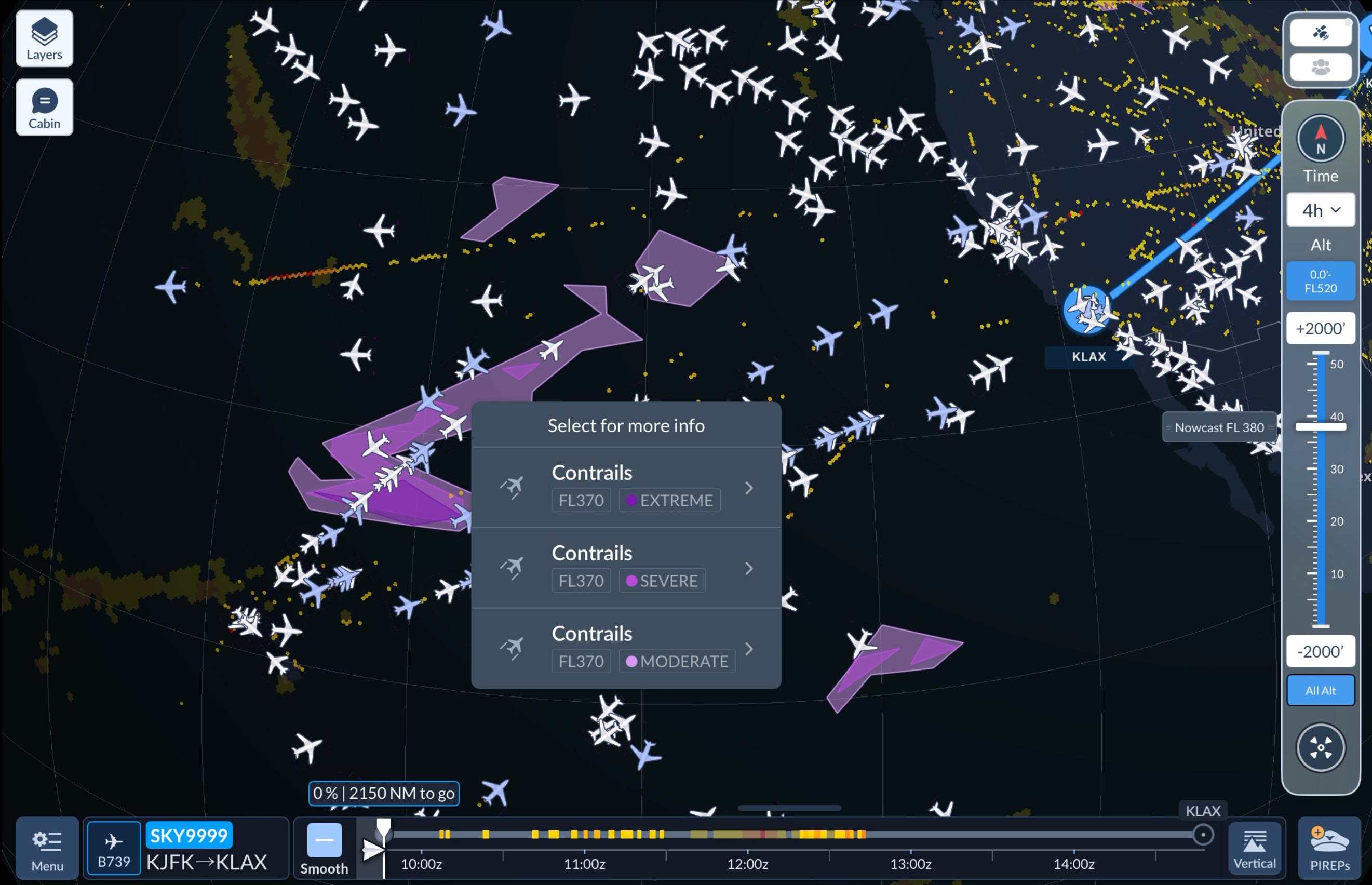
SkyPath’s OneLayer architecture serves as a unified foundation, connecting pilots, dispatchers, cabin crew, and safety teams into a single ecosystem. This “SkyPath 360” approach ensures situational awareness across the entire airline. For dispatchers, the platform provides live and predictive data to support both tactical and strategic decisions, while serving as a critical link to the flight deck.
For cabin crew, who experience the majority of turbulence-related injuries, advance warning can make a significant difference. SkyPath reports that its alerting capabilities have helped reduce those injuries by providing crews with additional time to prepare the cabin before turbulence is encountered.
This impact is made possible through state-of-the-art AI nowcasting models that provide global coverage and predict conditions up to 24 hours ahead. Recently, the company expanded its SkyPath Shield platform to include a GPS Interference Layer, helping crews identify and navigate modern threats such as jamming and spoofing.
Beyond Turbulence
While turbulence remains the foundation of the SkyPath platform, the company has recently expanded its focus into an area receiving growing attention across the aviation industry: non-CO2 climate impacts. Among these, contrails have emerged as one of the most promising opportunities for near-term climate action, leading airlines, regulators, and technology providers to explore ways of identifying and avoiding the atmospheric conditions that produce them.
For SkyPath, the move into contrails was not about entering an entirely new field, but about applying an existing operational platform to a new challenge.
Mike: SkyPath originally focused on turbulence, but now you’re expanding into contrail mitigation. What made you see contrails as the next major challenge to tackle?
Guy: The problem made it impossible to ignore. Aviation’s next frontier in climate action isn’t just about fuel, it’s about total climate impact. Contrails contribute 1-2% of global warming, comparable in magnitude to aviation fuel emissions, even though only about 10% of flights produce persistent contrails. And the impact is remarkably concentrated: just 2-3% of flights cause 80% of the warming effect. That’s one of the most cost-effective climate mitigation opportunities available today, often minor altitude adjustments are all it takes to prevent significant contrail formation.
From a product perspective, it’s a natural extension. Pilots and dispatchers already use SkyPath daily, so adding a contrail layer to the same interface means zero additional workflow. We’ve partnered with Google, who provides the contrail forecast. SkyPath brings that forecast into the cockpit and dispatch tools alongside Turbulence, so crews can make sustainable decisions without ever compromising safety, the two are designed to work together, not against each other.
Through their strategic partnership with Google, SkyPath has integrated a dedicated Contrails Layer powered by Google’s AI forecasting technology. Google’s models analyze satellite imagery and atmospheric data to identify Ice Super-Saturated Regions (ISSRs), the conditions most likely to produce persistent warming contrails. This partnership offers several key advantages:
Identifying High-Impact Contrails: The layer allows pilots to distinguish between contrails that have little climate impact and those associated with the greatest warming potential, helping crews focus on the scenarios that matter most.
Minimizing Operational Impact: Real-world testing has shown that many contrail avoidance maneuvers require only minor altitude adjustments. In some cases, contrail formation can be reduced by 54% while increasing fuel burn by as little as 0.3% across all flights.
Combining Climate and Safety Data: By displaying contrail forecasts alongside turbulence information, pilots and dispatchers can evaluate both considerations simultaneously, ensuring that sustainability decisions never come at the expense of safety.
The result is a tool that allows crews to visualize high-impact contrail regions up to 24 hours ahead and incorporate that information into normal flight planning and operational decision-making.
Integrating Safety and Sustainability
For SkyPath, the challenge is not simply identifying contrails, but helping crews make informed operational decisions when multiple factors are competing for attention. As Zunder emphasized, “You don’t want to avoid a contrail by flying into severe turbulence.”
Mike: In a real flight scenario, how does a pilot actually use the contrail layer alongside turbulence data to make a decision? Can you walk through a typical moment in the cockpit?
Guy: While en route, the pilot glances at the SkyPath map. Two layers are visible: turbulence, shown as a color-coded hexagonal grid, and contrails, shown as a color-coded overlay along the route. The pilot sees a high-impact contrail region ahead. The guidance suggests a minor altitude adjustment to clear it, the kind of small change that can meaningfully reduce warming impact. At the same time, the turbulence layer confirms the ride is smooth at the current altitude and at the suggested new one. The pilot requests the change from ATC, gets it, and the flight continues. No added workload, just a better-informed, more sustainable decision.
The reverse happens too. If a suggested altitude change would move the aircraft into moderate turbulence, the pilot sees it immediately and can hold altitude, pick a different adjustment, or stay the course. That’s the value of the two layers together: sustainable decisions never come at the cost of safety, and neither answer is right in isolation.
The integration of turbulence and contrail data reflects a broader shift taking place across aviation. As trials continue to demonstrate the viability of contrail avoidance, the challenge is becoming less about the technology itself and more about how these practices can be incorporated into everyday flight operations.
Standardizing the Future
Looking ahead, SkyPath is expanding its footprint with Predictive Insights, a strategic planning platform that gives airlines a full-year view of turbulence patterns to improve long-range network planning. When asked about the hardest problem still ahead, Zunder pointed not to technology, but to adoption.
Mike: What are you most focused on solving next, what’s the hardest problem still ahead for your team?
Guy: Two things.
The first is helping contrail avoidance move from early adopters into everyday industry practice. That’s as much a human and coordination challenge as a technical one. It takes operational evidence, regulatory clarity, dispatcher workflows, and pilot confidence all coming together, and we’re working on each of those in parallel. The science is ready. The next step is making the practice routine.
The second is continuing to deepen the intelligence we put in front of crews. Turbulence has been our foundation. Contrails are the natural next layer. Over time, we want SkyPath to be the place where safety and climate decisions live side by side, in the tools pilots and dispatchers already use. The goal is simple: make safer and more sustainable flying the easiest path.
As airlines continue searching for practical ways to reduce their environmental impact while maintaining safe and efficient operations, companies like SkyPath are exploring how tools originally built for flight safety can support sustainability as well. Whether contrail-aware operations become standard practice remains to be seen, but growing industry interest, new regulatory frameworks, and advancements in forecasting technology suggest that the conversation is only beginning.
Find them at:
SkyPath Official Website
SkyPath on LinkedIn