

Precision Navigation: The Latest in Contrail Avoidance
Recapping Some of the Most Recent Research Surrounding Contrail Avoidance

A flurry of research published over the past few months has really boosted both the awareness of and the data behind contrail avoidance. Scientific consensus confirms that persistent contrails act as a potent thermal blanket, trapping enough heat to rival the cumulative impact of aviation’s total CO2 emissions since the start of the jet age. As such, contrail avoidance is the aviation industry’s prime opportunity to eliminate a massive portion of its environmental impact.
The a landmark study in Nature Communications and latest findings from Transport & Environment (T&E) suggest that the industry is standing before its fastest and most cost-effective climate opportunity – provided it acts with surgical precision.
The Scientific Imperative
The January 2026 study in Nature Communications, “The climate opportunities and risks of contrail avoidance,” provides a high-stakes timeline for the aviation industry. Researchers emphasize that the greatest risk to the climate is not the difficulty of implementation, but the cost of delay.
The 9% Recovery: Implementing a 100% effective contrail avoidance strategy by 2035 could recover 9% of the world’s remaining 0.5 K temperature budget under the Paris Agreement [+2 °C limit].
The Inaction Penalty: For every year the industry delays, the world will be on average 0.003 K hotter by 2050.
The Cost of a Decade: Delaying action by just ten years (starting in 2045 instead of 2035) reduces the budget recovery to only 2%, representing a 78% loss in total effectiveness.
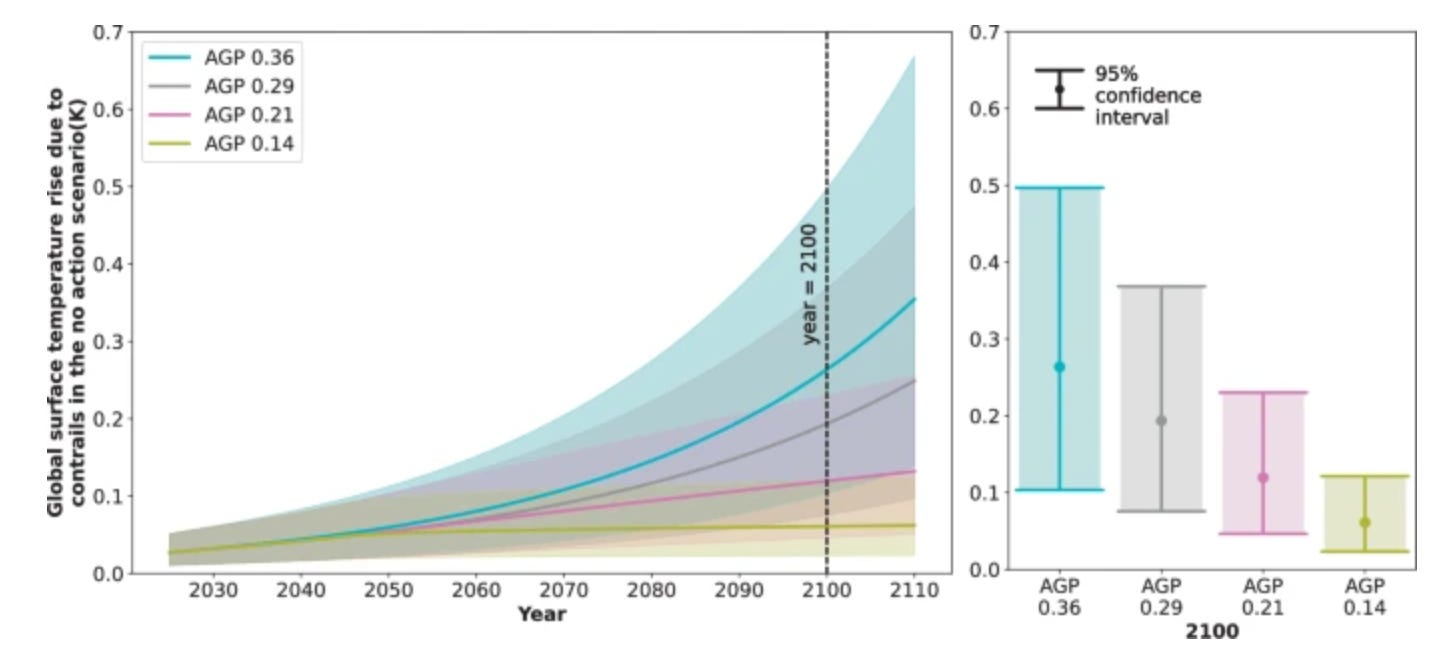
The study also firmly addresses the “CO2 penalty” – the extra fuel burned to reroute planes. The data reveals that the warming from additional CO2 emitted during avoidance is “two orders of magnitude lower than the expected contrail warming reduction.” Even under pessimistic 10% fuel penalty scenarios, the contrail warming reduction is at least 15 times greater than the CO2 penalty.
The 3% Rule and Operational Hotspots
While climate modeling provides the “why,” the T&E report, “Managing complexity: How to scale up contrail avoidance in Europe?,” provides the operational “how.” The report reveals that contrail warming is a remarkably concentrated problem:
The 3% Rule: In 2019, just 3% of flights were responsible for 80% of total contrail warming.
Seasonal and Temporal Hotspots: 75% of European contrail warming occurred in just six months (January–March and October–December). Furthermore, 25% of all warming comes specifically from night flights in autumn and winter, despite these making up only 10% of traffic.
Targeted Airspace: T&E suggests focusing first on the North Atlantic, an area dominated by high-impact long-haul flights but characterized by low traffic density, making rerouting maneuvers safer and easier to manage.
Alexander Kunkel, Senior Analyst at T&E, explains: “The science and the solutions are clear: by adjusting the paths of just a handful of flights, Europe could prevent years of avoidable global warming.”
The Estuaire Contrail Opportunity Index
Adding a new layer of flight-by-flight accountability is the Estuaire Contrail Opportunity Index. This dataset analyzed 38 million commercial journeys in 2023, estimating that contrails contribute an additional 16% environmental impact globally beyond direct CO2 emissions.
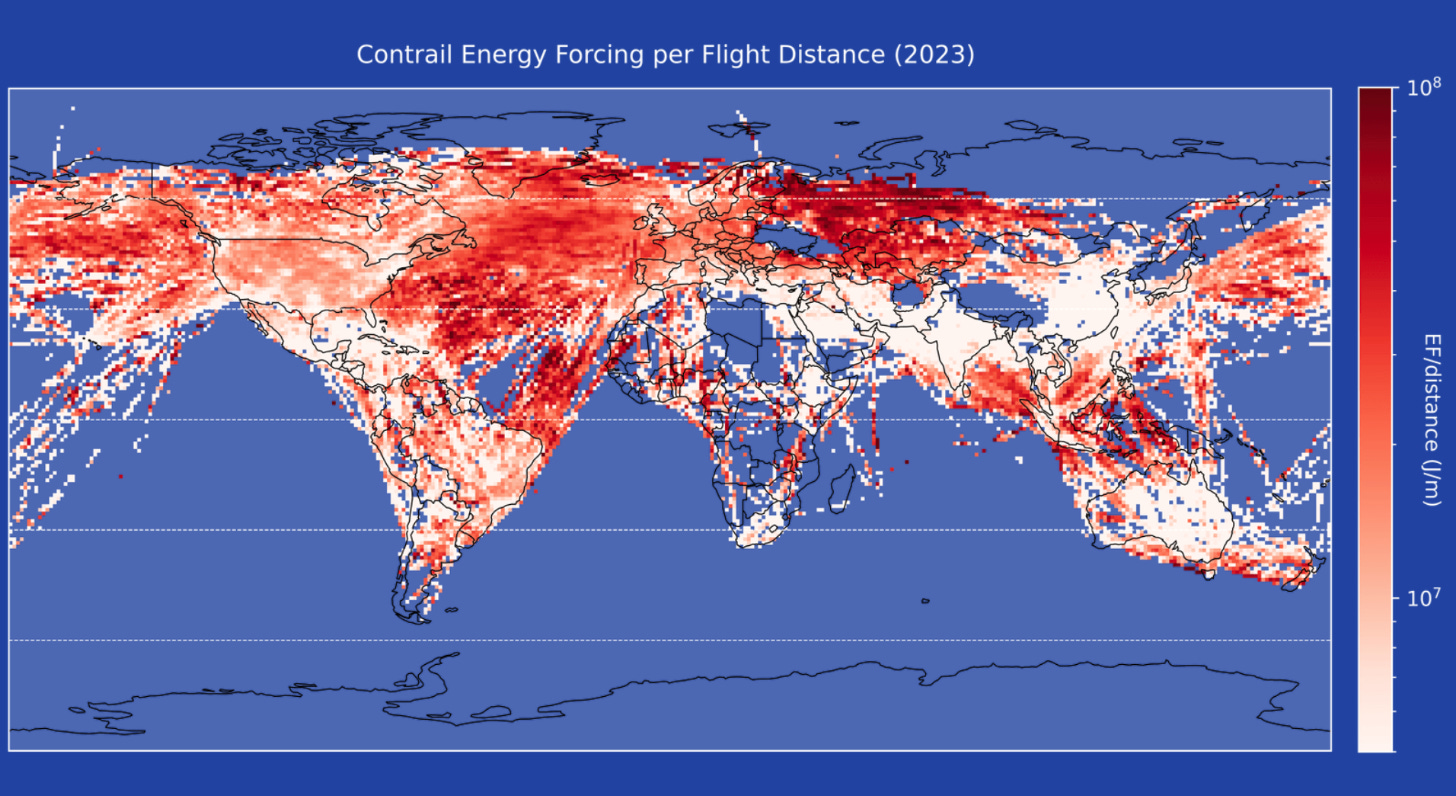
The index identifies specific airlines where the climate footprint is heavily influenced by contrails:
Wizz Air Hungary: 43.24% of total climate impact is contrail-driven.
Aeroflot: 40.13% of total climate impact is contrail-driven.
JetBlue: 34.92% of total climate impact is contrail-driven.
By identifying big hit routes – such as London Heathrow to John F. Kennedy International – this index allows regulators and airlines to prioritize interventions where the climate gain is guaranteed to be highest. Notably, these estimates are considered conservative, as current models may still underestimate contrail characteristics for the latest generation of soot-poor, lean-burn engines.
Side note: Estuaire will be hosting an ATC Webinar to discuss operational insights on contrail avoidance and capacity management on March 19th. Find out more here.
Managing Complexity with AI and Risk-Awareness
As the industry moves from theory to practice, researchers are addressing the complexity of a contrail-aware sky. Rerouting many flights away from warming zones can lead to localized congestion. To solve this, researchers have introduced Deep Multi-Agent Reinforcement Learning (MARL) frameworks. These AI systems allow aircraft to make decentralized, real-time adjustments to speed and altitude. Experiments using real European traffic data show these frameworks can achieve a 24% mitigation in climate impact while maintaining standard air traffic safety levels.
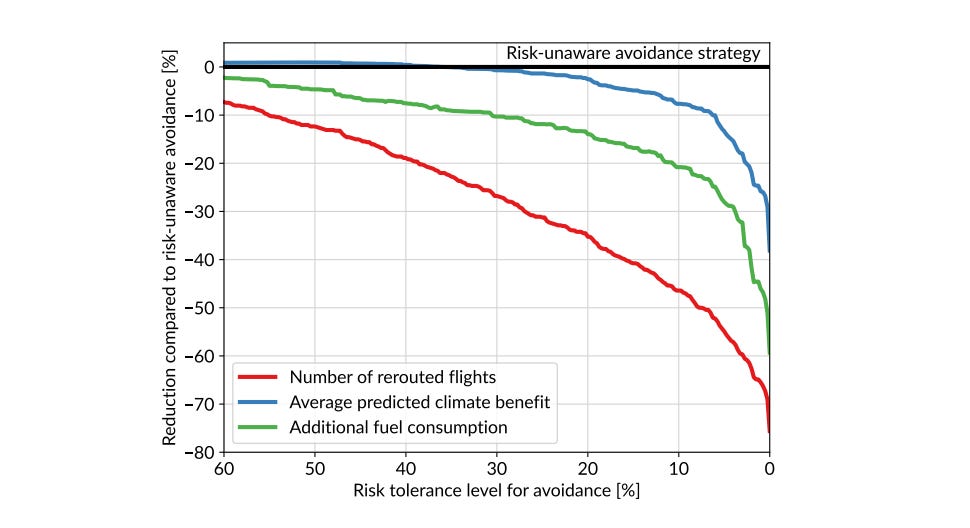
Simultaneously, a February 2026 paper (preprint) introduced “risk-aware contrail avoidance strategies.” Because current weather models have inherent uncertainties, approximately 55% of proposed reroutings currently carry a higher-than-5% risk of unintentionally damaging the climate if the avoidance fails but the CO2 penalty is still incurred. The solution, researchers argue, is to focus exclusively on the high-impact flights where the potential climate benefit far outweighs the risk of model error.
Closing the Detection Gap
Verifying the success of avoidance maneuvers is now a technological priority. A December 2025 MIT study revealed that geostationary satellites miss approximately 80% of the contrails detected by higher-resolution low-Earth-orbiting (LEO) satellites. To fill this gap, international projects like BECOM (Better Contrail Mitigation) are turning to ground-based LIDAR and all-sky cameras to provide ground truth for contrail formation in real-time.
Furthermore, simulation breakthroughs into airliner geometry show that air swirls created by structures like the horizontal tailplane can make contrails wider and denser than previously estimated. For a large jet like the A380, these effects can result in 20% greater total extinction (heat trapping) than smaller regional jets, suggesting that future aircraft design may eventually include contrail-conscious aerodynamics.
Summary
The landscape of contrail avoidance has shifted from theoretical research to an urgent operational mandate. As the studies show, inaction is the single greatest climate risk, carrying a 0.003 K temperature penalty for every year of delay. Operationally, the problem is surgical: by targeting just 3% of flights – particularly during autumn and winter nights – the industry can achieve massive cooling effects with minimal disruption. As AI-driven management tools and precision indexes fill the remaining technical gaps, the roadmap for a contrail-aware aviation system by 2035 is becoming a regulatory imperative and a technical possibility.
Let’s shoot the elephant in the room.
There is NO multi-percent fuel penalty.
Even if airlines carry out ISSR avoidance deviations whilst maintaining planned Cost Index (ie planned cruise speed) for the flight, the fuel penalty for the flight in question might be anywhere between zero and a couple of percent. That is for the specific flight in question and the outcome will vary depending on the wind field across different flight levels.
If the number of flights needing to deviate for ISSRs is only, say, 5% then the fuel penalty averaged across the entire airline’s operation will be one twentieth of that amount. Perhaps a total of 0.1% of total fuel burn?
Going further, if aircraft carrying out ISSR avoidance reduce their Cost Index (ie cruise speed), they will trade reduced fuel burn for extended flight time. In many cases this will allow ISSR deviations to be carried out for ZERO fuel penalty, especially on longhaul flights.
This is no different to the way that pilots deal with flying “off level” eg due to turbulence or other aircraft occupying their flight planned cruise level.
How do I know this?
Retired airline Captain for a large international airline, with aeronautical engineering background.
People need to stop talking about “fuel penalties incurred by ISSR avoidance” because such fuel penalties are negligible… indeed, with a slight tweak to operating philosophy, the “fuel penalty” could be ZERO.
Talk of fictitious multi-percentage “fuel penalties” is killing the chance of live contrail mitigation ops being implemented at scale.