


Since the previous articles have been a bit lengthy, we wanted to offer a reprieve with a brief glimpse at a potentially game-changing website. Contrails.org, a rebranding of Breakthrough Energy’s Reviate, has recently been launched with the objective of raising awareness of the climate impact of contrails and the work going into contrail management.
The website is part of a consortium of organizations from across the aviation industry. These organizations represent the fields of research, technology, and operations surrounding contrails. In a recent episode of the Sustainability in the Air podcast, Matteo Mirolo, the director of strategy and external relations for Contrails.org, said, “we’ve built an ecosystem of quite a few academics, practitioners from the industry, policy makers, civil society and we get them all together and aim at catalyzing more work and more results on this contrail piece.” This focus on collaboration is vital to finding cross-sector solutions.
To better understand the science behind contrails - with an overview of contrail avoidance - Contrails.org provides an insightful introductory explainer video (among other useful features).
Website Features
Contrails.org is built on three main pillars: science, technology, and adoption. With these pillars they are able to advance the research on contrails, demonstrate the feasibility of contrail avoidance, and foster the methods required to introduce contrail mitigation at scale. All of these measures are ultimately designed to raise awareness and advance the public understanding of contrails.
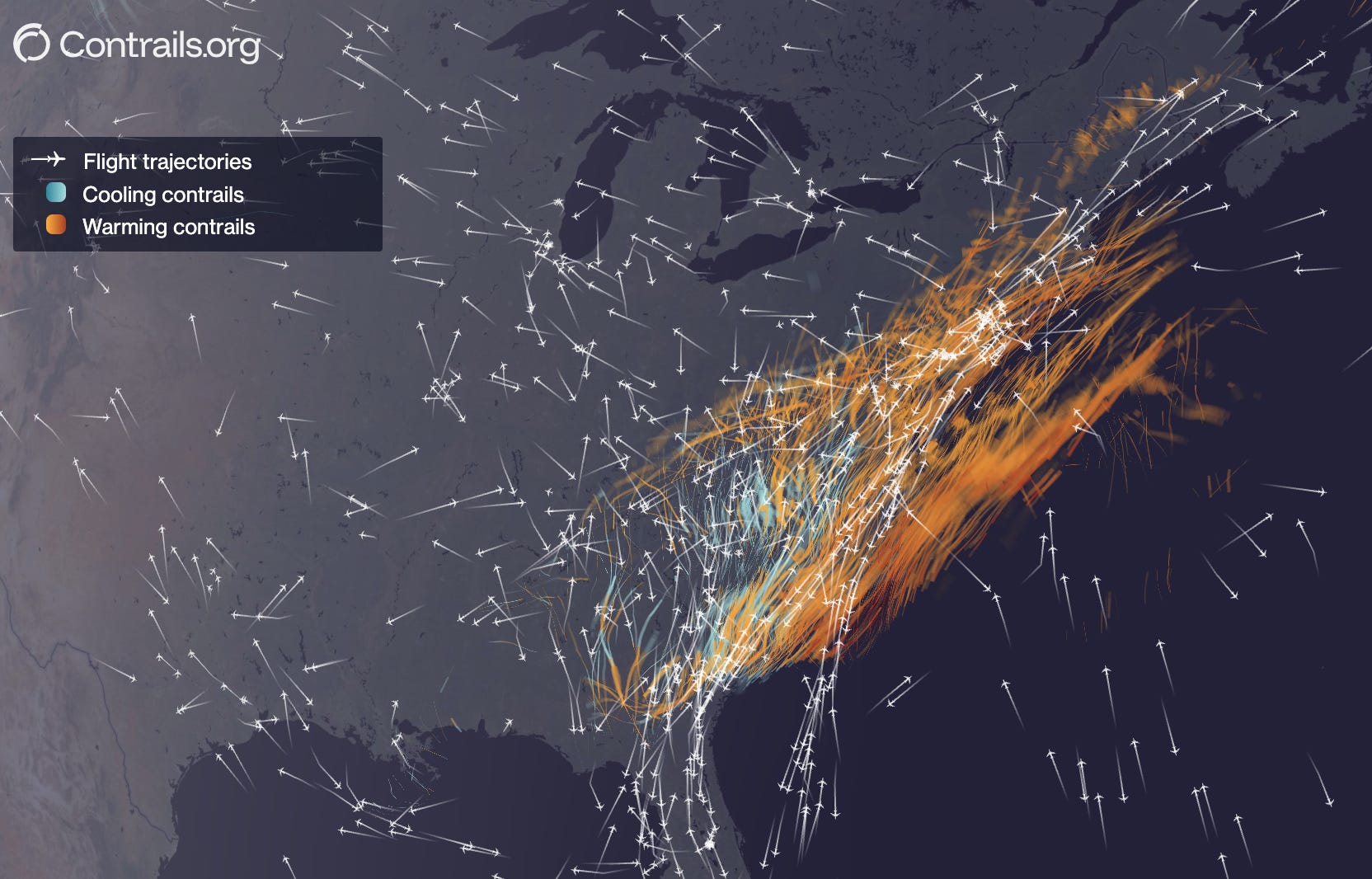
To aid in that advancement, Contrails.org has established a couple of handy features on their website. One being the contrails map. This interactive tool provides a detailed look at contrail formation around the world. By combining satellite imagery and prediction models, they are able to decipher the development of high-impact contrails and see whether they would be warming or cooling. Not only is this a fun way to explore regions of higher contrail likelihood and learn about contrail formation, but it can also be harnessed for implementing contrail avoidance measures.
The other interesting feature offered is the notebook. Though it doesn’t have much content yet, the blog-like feed looks to be a great resource for the latest insights and breakthroughs in contrail research. This notebook would act as a news outlet for recent progress and will provide updates on the ongoing work at Contrails.org, so be sure to check in regularly.
As the contrail conversation continues to expand and evolve, having a reliable source of up-to-date information becomes integral. Therefore the initiative undertaken by Contrails.org will broaden the scope of understanding around contrail management and accelerate its implementation. The spirit of collaboration driving this initiative is emblematic of the sentiment throughout the aviation industry: to work together to meet challenging goals and, in time, achieve sustainable and environmentally conscious flight.