

Breaking Down Aviation Nitrogen Oxide (NOx) Emissions
A Comprehensive Assessment of Atmospheric Impact, Technology, and Policy

Nitrogen oxides (NOx), specifically nitric oxide (NO) and nitrogen dioxide (NO2), represent a critical byproduct of high-temperature and high-pressure combustion in modern aviation engines. While carbon dioxide (CO2) remains the primary focus of long-term climate strategies, recent assessments suggest that non-CO2 effects—with NOx as a chief contributor—account for more than half of aviation’s total net climate forcing. NOx is categorized as a “key gaseous pollutant of concern” due to its influence on both global radiative forcing and surface-level air quality.
The environmental impact of NOx is characterized by a complex atmospheric tug-of-war. In the upper troposphere, NOx acts as a catalyst to produce short-term ozone (O3), a potent greenhouse gas that traps heat at flight altitudes. Simultaneously, NOx increases the concentration of hydroxyl radicals (OH), which accelerates the destruction of ambient methane (CH4), providing a long-term cooling effect. This dual nature is highly sensitive to altitude; for instance, ozone production is significantly more efficient at cruise levels than at the surface, while an ozone-neutral threshold exists at approximately 14 km, above which NOx emissions can lead to net ozone depletion.

Recent Research and Modeling Advancements
Scientific inquiry over the past year has utilized multi-model intercomparisons to refine the significant uncertainties associated with aviation NOx:
Radiative Forcing Consensus (Sep. 2025): State-of-the-art research by Cohen et al. harnessing five innovative global models found that the net Effective Radiative Forcing (ERF) of aviation NOx remains systematically positive (warming), with values ranging from 7.3 to 22.1 mWm-2.
Model Sensitivity and Background Conditions (Dec. 2025): A multi-model study by Staniaszek et al. demonstrated that inter-model variability in ozone response is often larger than the effect of different future pollution scenarios. In certain high-mitigation scenarios, some models predict that negative methane forcing may become strong enough to shift the net climate impact of NOx to negative (cooling).
The Supersonic Paradox (Feb. 2026): Oh et al. identified a teleconnection where NOx emitted at stratospheric altitudes (20–22 km) for future supersonic flight depletes the ozone layer, allowing increased UV radiation to reach the troposphere. This process accelerates the formation of sulfate aerosols, resulting in a ninefold increase in surface-level fine particulate matter (PM2.5) per unit of NOx compared to subsonic aviation.
Engineering for Emission Reductions
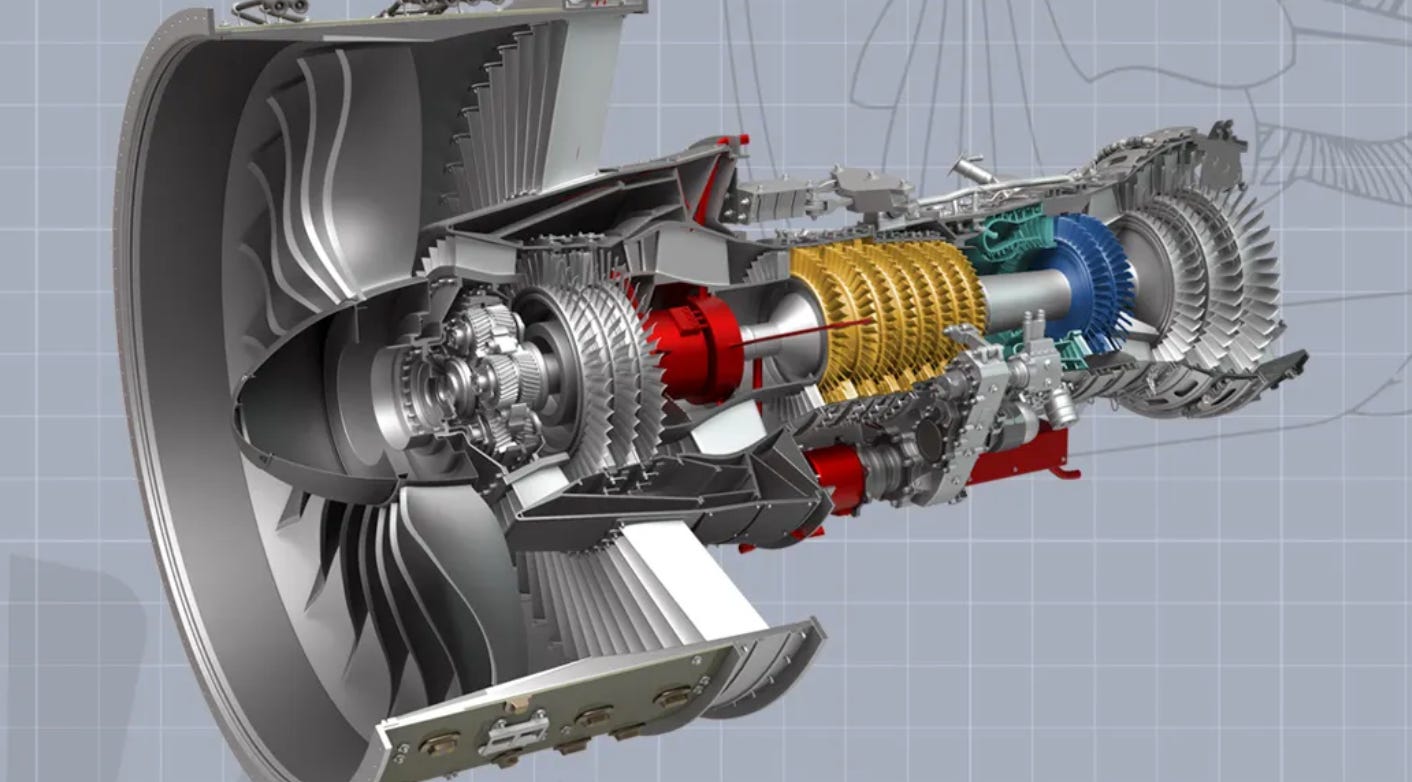
Engineers face a fundamental thermodynamic challenge: higher combustor temperatures and pressures improve fuel efficiency and reduce CO2 but inherently optimize the conditions for NOx formation. NASA’s Sustainable Flight National Partnership (SFNP) and the Hybrid Thermally Efficient Core (HyTEC) project are currently leading research into lean-burn and staged combustion architectures. These designs aim to ensure that the majority of fuel-air combustion occurs under conditions that avoid the extreme temperature peaks responsible for the dissociation of nitrogen and oxygen molecules.
However, technology transitions present distinct trade-offs. While Sustainable Aviation Fuels (SAF) provide substantial benefits for CO2 and particulate matter, their direct impact on reducing NOx emissions is currently estimated to be small, often only a few percent. Furthermore, while direct hydrogen combustion eliminates CO2 emissions, it still produces NOx and increased water vapor, necessitating entirely new engine architectures to prevent worsening non-CO2 effects. Operational strategies, such as flying 2,000 feet lower, could reduce NOx radiative forcing by approximately 30%, but these measures typically incur a CO2 penalty as engines work harder in denser air.
Monitoring and Field Verification
As models improve, the aviation sector is increasingly focusing on bridging the gap between theoretical simulations and real-world data collection. The IAGOS program (In-Service Aircraft for a Global Observing System) utilizes commercial aircraft to gather long-term, in-situ measurements of ozone and nitrogen compounds in the upper troposphere and lower stratosphere. These data are vital for validating the chemistry-transport models that predict NOx impacts.
In June 2025, the REVEAL-NOx project, led by the National Centre for Atmospheric Science and the University of Cambridge, began research flights to directly measure NOx emissions within UK flight corridors to constrain model uncertainties. Additionally, the DLR utilizes instrumented research aircraft, such as the Falcon, for chase flights to probe emissions and contrails at distances ranging from 50 meters to 100 kilometers behind preceding aircraft. These efforts are essential for characterizing the chemical cascades that occur immediately after emission and ensuring that regulatory metrics accurately reflect physical reality.
Surface Air Quality and Public Health Impacts
Beyond climate warming, aviation NOx is a primary driver of ground-level air pollution. While more than 90% of aviation NOx is emitted above 3,000 feet, these emissions contribute significantly to background levels of surface ozone and fine particulate matter. Studies have estimated that aviation-attributable ozone and PM2.5 were responsible for approximately 16,000 to 21,200 premature mortalities globally in 2023, with a significant portion of this impact driven by cruise-altitude NOx emissions. At the local level, NO2 concentrations in residential areas near major airports can be heavily influenced by the landing and take-off (LTO) cycle, with aviation contributing up to 38-55% of NO2 at airport locations.
Navigating Stringency and Metrics
Regulatory frameworks are shifting from a focus on local air quality to a more holistic consideration of climate impacts:
ICAO Standard Setting: During the CAEP/13 meeting in February 2025, regulators recommended a new process to set more stringent LTO NOx standards by 2028. Proposals include shifting existing regulatory lines for “NOx-neutral” improvements and placing a cap on maximum emissions per unit of thrust.
Cruise Metrics: Acknowledging that ground-level tests do not perfectly predict high-altitude performance, ICAO is investigating a new reporting point at 57.5% of rated thrust to better characterize emissions during the cruise phase.
European Market Measures: The EU Emissions Trading System (ETS) established a non-CO2 monitoring, reporting, and verification (MRV) framework on January 1, 2025. This system is intended to provide the high-quality data necessary for a 2027 legislative proposal that could formally expand the scope of the EU ETS to include NOx emissions.
Conclusion
Aviation NOx remains a multifaceted atmospheric challenge that requires the industry to balance immediate air quality benefits at the surface with long-term global climate objectives. Recent research has highlighted the critical importance of emission altitude and the chemical sensitivity of the background atmosphere in determining the net impact of these emissions.
As technological breakthroughs like lean-burn combustors and hydrogen-electric systems move toward maturity, they must be integrated with holistic regulatory frameworks that internalize the environmental costs of both CO2 and non-CO2 gases. Ultimately, achieving a sustainable aviation sector will require a synchronized strategy that combines advanced engine engineering with data-driven atmospheric science and adaptive global policy.